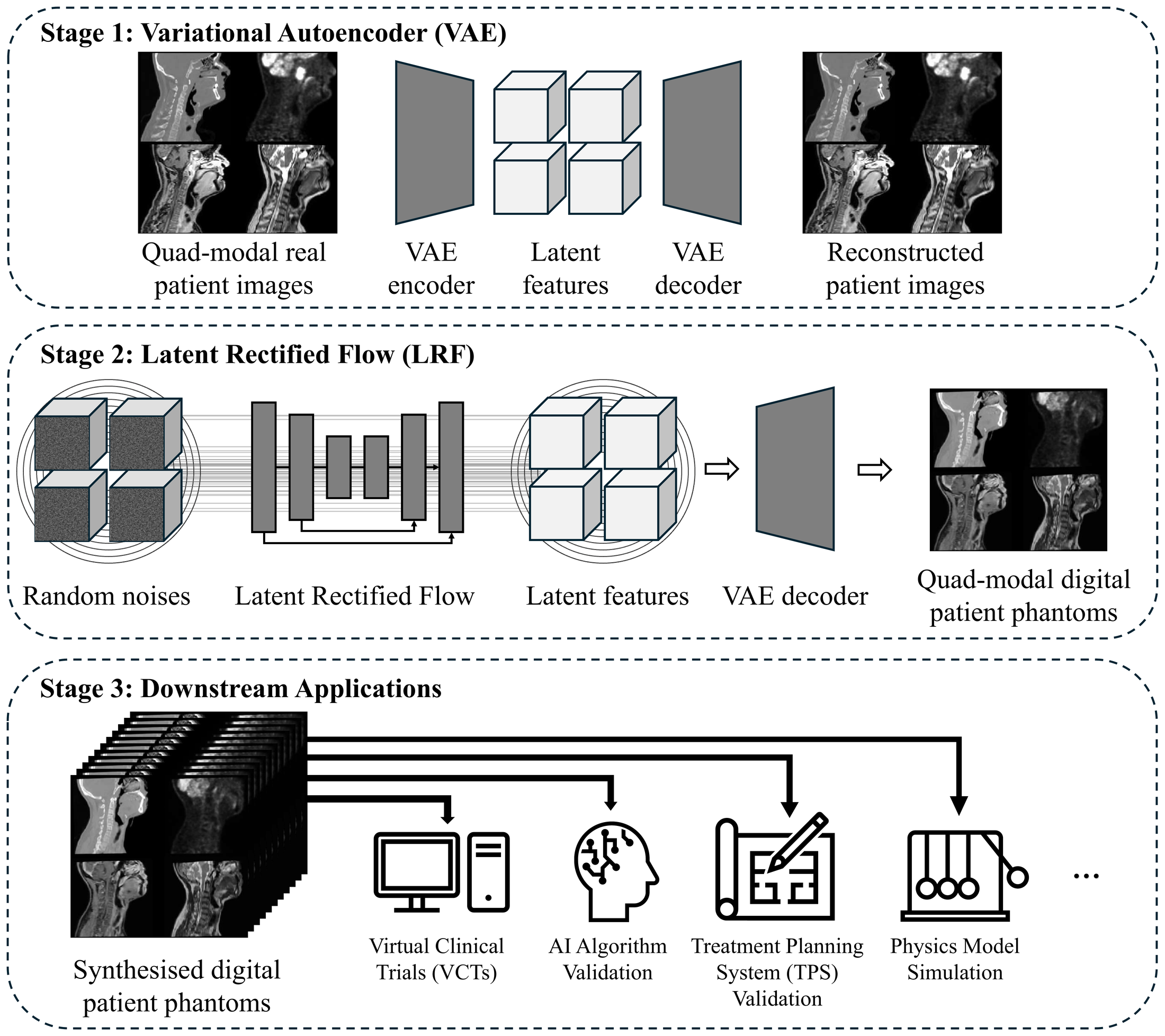
We learn the joint distribution of co-registered CT, T1w MRI, T2w MRI and 18F-FDG PET from 609 head-and-neck cancer patients, and generate brand-new quad-modal 3D phantoms in a handful of deterministic steps. The cohort below is sampled from noise — no patient appears in it.
Method
A medical VAE compresses each four-modality study into a 16-channel latent; a 3D U-Net trained as a latent rectified flow transports Gaussian noise to a co-registered quad-modal phantom along a near-straight path.
Explore the generated cohort
Ten synthetic patients, each a single voxel-aligned volume across all four modalities. Scroll the slices, drag on any panel to move the crosshair, switch each modality between colour and grayscale, and either fuse the modalities into one overlay or compare them side by side in a 2×2 grid — just like a tri-planar reading station.
Tip: in Fused overlay, enable CT + FDG PET and flip PET to colour for a hot-metal fusion; switch to 2×2 modalities to read all four side by side at the same slice.
Can you tell real from synthetic?
A public online reader study, in which clinicians and the community are invited to discriminate real patient scans from our generated phantoms, is currently being prepared.
Public survey — coming soon